


Most of you are reading this because your vision is blurry, and you know it means your eyes are unfocused, with the same general effect of a blurry image as holding a magnifying glass at the wrong distance (or perhaps holding the wrong shape of magnifying glass at a given distance).
One of the main principles for you to understand is how tense eye muscles play a major role in blurry vision. The more relaxed your eye muscles are, the better your eyes will function, and the better they function, the better the system focuses. So one purpose of the methods presented here is to get you to understand how to relax your eyes and also how to become more conscious of the excess tension your eye muscles are currently holding.
You can look at the issue from various perspectives. Behavioral optometrist Ray Gottlieb, in his 1978 PhD dissertation, “The Psychophysiology of Nearsightedness,” suggests that people with myopia are stuck a in fight-or-flight-or-freeze response of the sympathetic nervous system, which serves an immediate purpose but has numerous physical consequences when it’s perpetuated long-term. For the purposes of the study he looked at myopia only. When you are stuck to some degree in the “freeze” state, your muscles are tight and do not move freely. The muscles are contracted as if in action, perhaps because you want to act but are conflicted and don’t know what to do. Mentally you feel anxious or unsure, even if you try to cover it up. The nervous system is beyond my area of knowledge, but I think it’s interesting, so check out the above link if you want to understand the perspective further.
Your number one priority is to keep your eyes as relaxed as you can, at all times. This will remain your first priority throughout the method I describe here. It is always the first step. So when you follow later instructions, you always check first to make sure you’re keeping your eyes relaxed, and keep checking to make sure you haven’t tensed them up in an effort to perform the other instructions.
I will explain in more detail what relaxing your eyes means and how you can be confident about whether you’re doing it.
There are a few muscles that are connected to your eyes, and another couple of muscles inside your eyes. You can’t touch any of these muscles in order to identify them and figure out how tense they are, but fortunately that is unnecessary. There are a lot of muscles in your face that technically have nothing to do with controlling your eyes, but chronic tension often occurs in groups of adjacent muscles, so relaxing the rest of your face can very much help relax your eyes. So you may not know what relaxed eyes are supposed to feel like, but you are able to tell if the muscles of your face near your eyes are tense, and you should be able to relax those on command, and that’s all you need to do! Or more accurately, that may be all you CAN do, as far as this part goes.
As you relax your face, notice how much more comfortable it feels. But notice you can also use the muscles of your face while keeping them feeling relaxed. Relaxing muscles in the context used here does not necessarily mean staying completely limp and immobile. It may mean that somewhat, as there is no reason to contract most facial muscles in order to see, but more specifically when I use the word “relaxation” here I mean the absence of unnecessary tension. So when you relax your face, that doesn’t mean you have to let your jaw hang open. That’s the thing, if you have a purpose for using the muscle, like keeping your mouth shut, keeping a certain amount of tension is useful. What you want to be doing here is avoiding the type of chronic tension that has the nervy or achy feeling.
It’s also important to stay as relaxed as possible so that you’re teaching yourself that this process is easy and something you can keep doing all day, every day as part of your normal perception. The way to become as relaxed as possible in the moment is to check other functions of your body for signs of tension and then stop or modify the actions in those other body parts that are causing the tension. Patterns of tension, due to reasons I don’t fully understand, spread throughout the body, and they can dissipate in a similar chain-reaction. Dysfunctional blinking or breathing in particular can be major culprits to excess tension around your eyes.
Blinking is important to make sure the front of your eyes remain moist and the cornea maintains a complete and even layer of film over it to ensure that the light rays pass through smoothly. Blinking should be quick and soft. You might have a habit of slow, effortful blinks, where you slowly smash your eyelids together. It might help to know that with a good blink you don’t have to make sure your eyelids touch. It should be just a light flick.
Breathing is something that often suffers when you’re concentrating on something, but that’s a bad habit that you need to break. Especially when you’re concentrating on doing this process right, it’s important to keep breathing deeply and maintain a full supply of oxygen to your brain. Focusing on your breath can also be useful, as I describe further below.
Also check your neck, shoulders and face to see if you notice any obvious tension you’re holding. Chronic tension can also be a form of armoring, or protection from perceived threats, whether the threats are emotional or physical. Trigger point therapy to loosen knots is pretty interesting too. Plenty of physical exercise involving tense body parts, including lots of warm-up and stretching, should help. Any type of physical sports or martial arts training is a good influence, because you do them with the intention of learning to use your body efficiently to accomplish tasks, and that’s what you’re learning to do with your eyes as well.
Bodily tension is a huge topic, and entire books and modalities have been dedicated to relieving it. I’m just giving a few suggestions.
Your thoughts can also cause you problems. The vision improvement process is very mental, and your thoughts can take you off-course so that you’re thinking about something totally unrelated as you practice looking at details. For this process to be effective, you have to remain focused on it. The way to prevent your mind from running amok with random thoughts is to focus on something outside the words running in your head, and understand that you do not require the endless stream of words in your head to continue functioning. Your breath is an extremely handy tool for this. Practice concentrating on the sound, feeling and rhythm of your breath, and remind yourself to notice it frequently as you practice the vision improvement process. It will keep you calm and focused.
All you’re doing in improving your vision is learning something that you should already know. Keep in mind that there are a lot of seemingly incapable people out there who nevertheless have good vision and are able to do these simple things without effort. It will feel strange as you get used to seeing correctly, and it will take repeated work and reminders, but there’s a difference between that and finding yourself doing weird things with your eyes that are not a part of the process of easy, relaxed vision.
Tensed Eyes
Muscles often become tense in a whole area of the body at once. You might get multiple knots in an area of your back. And if you develop a pattern of tension in your cheek muscles, forehead, and other muscles around your face, it’s easily to imagine how the nearby tension can spread to your eye muscles. This may be one factor in how people develop vision problems. At first it’s just a temporary issue of tense muscles. But tense muscles don’t work as well. They’re slower, jerkier. The signals get messed up. You use your eyes constantly all day long, and they need to be in a relaxed state so they can work efficiently without suffering negative consequences from all the work. When they become tense, just the act of using them for some activities becomes tiresome and uncomfortable. Do your eyes tire quickly while you read?
If you don’t change your ways and drop the habit of excess muscular tension, it becomes chronic, and you get used to using your eyes while they’re all tensed up. Before long it becomes part of your programming, and you don’t know how to use your eyes anymore without tensing them up.
Many muscles you can address directly and help to relax by massaging them. It works, at least until you misuse your body and the muscles become tense again. The eye muscles, however, you can’t address with your hands. And really when the vision problem becomes chronic, it’s no longer a problem of just tensed muscles that you need to relax, but a habit of re-creating the tension in every moment as you use your eyes in this new dysfunctional way. So if you work on relaxing your facial muscles it may help relax your eyes somewhat, or to a large extent but only temporarily. You find that it’s very hard to keep your eyes relaxed, even with constant reminders, because the way you’re using your eyes is what is now creating the tension. This is the quandary that people trying to improve their vision find themselves in. They have confirmed over and over again that relaxation helps their vision, and that the solution lies somewhere in learning how to relax more and stay that way. They just need to address the way they use their eyes in the right way, and then the relaxation practice will be much more effective.
So you have to change your visual habits, including a few simple things about the way you move your eyes and how you think about the seeing process. It’s a mental thing. It just takes some practice and dedication, and with the right beliefs you can’t fail.
An Example: Tensing the Muscles of Your Hand
Hold your hand out, fingers spread, and hold it very rigid, involving your forearm muscles to make your hand nearly as tense as you can. Then, keeping your hand tensed up, move your fingers into a fist, and back out again. You are very aware of the movement of your hand, and you can only do this slowly while your hand muscles are under so much tension, and you may feel some pain in spots.
Now relax your hand and forearm. Move your fingers into a fist and back out again with a minimum of effort. Notice how quickly you can move it. When your muscles were tense, they function poorly, and when they are relaxed, they function easily, comfortably, quickly, and in-sync, almost effortless.
Now imagine what this kind of tension would do to your eyes. They are meant to be in motion constantly, with tiny movements called microsaccades that you can’t possibly count. But these microsaccades can’t occur if the muscles are too tense, and without them the whole system of visual functioning is impaired.
Palming
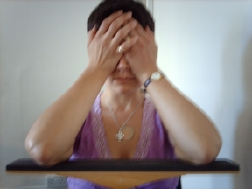 This is something Dr. Bates recommended, but I’ve heard it was a part of yoga long before he was around. It’s surprisingly effective.
Close your eyes and cover them with your hands, in such a way as to exclude all (or almost all) light, and where you are not touching your closed eyelids with your hands.
Support your elbows if it helps. On a high enough table in front of you may be easiest, but even just resting your elbows on your knees is fine. Or just sit upright and don’t support your elbows with anything, if you’re doing this for only a short period of time.
There’s something about covering your eyes in this way that helps you to relax your eyes. Certainly the darkness helps, but I think part of it has to do with the sense of safety from covering your eyes with your hands. You might have a bit of a mental hangup, or conflicting beliefs, about whether it’s ok to completely relax your eyes and let them be as comfortable as possible, and there’s a certain soothing comfort when you cover your eyes with your hands. It’s similar to covering an injured body part with your hand, in that it helps with the pain somehow. The feeling of over-work or strain of your eyes can be somewhat relieved by doing this, allowing them to feel better and relax more as a consequence.
People have also speculated that there is energy coming from your hands that permeates to your eyes and helps them, but I think the important thing about palming is whether you get any sense of relief when doing it.
Some sources also recommend things like cold packs, hot washcloths, or hot rice bags, but in general I think it’s best to avoid placing any pressure at all on the eyelids or eyes. They’re very sensitive, as shown by how easily you can get a “black eye”.
Palming is an opportune time to practice other methods, such as breathing and visualization.
Meditation
Dr. Bates understood that his method involved relaxing the mind, but back in the early 20th century the idea of meditation was largely unknown in Western culture. If Bates were around today, with meditation being a household word and many approaches to it freely available on the internet, he would have been all over it. So the closest he really got was palming, as described above.
Tom Campbell, consciousness expert, quantum physicist, and author of the trilogy My Big TOE, suggests Transcendental Meditation, which to me looks like a very protected system that you need to sign up and learn from a teacher. I’ve listened to Tom’s books (in audio format) and watched his lectures and discussions, and let me tell you, he’s a smart cookie. In his younger days he worked heavily with Robert Monroe, researcher of human consciousness and author of Journeys Out Of The Body and other books.
Speaking of Robert Monroe, I bought “The Gateway Experience” set of 18 audio CDs put out by the Monroe Institute, and as of writing I’m working my way through the early ones, repeating them and practicing on my own. I got lucky and bought a used set of them on eBay for less than they sell for new. The program provides a sort of consciousness roadmap to help you make sense of where you are as your brainwaves slow down. It uses Hemi-Sync technology, which is basically what I had previously posted about in “Meditation and Binaural Beats.
Meditation will teach you that relaxing your muscles and calming your mind takes some time, especially when you’re first learning, and you have to set your intent and give it a moment and not try to force anything. But learn to meditate and you will reap the rewards in better physical relaxation, mental clarity, calmness, and awareness. All of these things will help you succeed in improving your vision. Today many of us are constantly bombarded by stimulation, and it’s necessary to be able to sort of return to yourself to not get caught up in all the stress and franticness.
Practical Application
Below is a summary of practical suggestions for applying the above ideas. The ideas and reasoning are more fully fleshed out above. Each of the suggestions are separate (this is not step-by-step) but may be combined as you see fit. They are also included in the Practical Applications page at the end of this guide.
- Progressive Muscle Relaxation involves going through all your muscle groups, tensing and relaxing them each in turn, to create awareness of tension that you’re holding.
- Modified Progressive Muscle Relaxation: I prefer a mental method of progressive relaxation that I use to prepare for meditation. Lie down, close your eyes, and take some full breaths, not as deep as you can but a little deeper than normal. Mentally go through your body and imagine each muscle group relaxing. Do several muscles on your face, including your cheeks, forehead, eyelids, eyes, and throat, and then the rest of your body, in any order you want. It’s such a simple thing, but it’s effective and only takes a minute or two.
- Breathing. Whenever you catch yourself breathing too shallowly, take a moment to restart better breathing. Focus on your breath to become calmer when you feel anxious or stressed.
- Blinking. Practice soft, effortless blinks. They don’t have to be slow, and you don’t even have to close your eyes all the way, so there’s no need to smash your eyelids together.
- Meditation. Try a few approaches until you find what works for you.
- Palming: As described further above, palm for brief or long periods of time. I suggest shorter periods, or you may avoid doing it.
- Flashing: Sit in front of the eye chart. Alternate palming for a moment and opening your eyes briefly, making no attempt to focus your eyes. Don’t even make an effort to look at the eye chart or any particular letter. Just see what you see, keep your eyes open only for an instant, them close and cover them again.
- Massage: Trigger point therapy, massage and foam rolling can help relax tense muscles. You can massage around your eyes, but don’t massage your eyes directly.